Metallic Yarn vs. Lurex Yarn: What Is the Difference? A Technical Buyer’s Guide
From material composition, construction & structure, dyeing performance and ect.
What’s the difference?
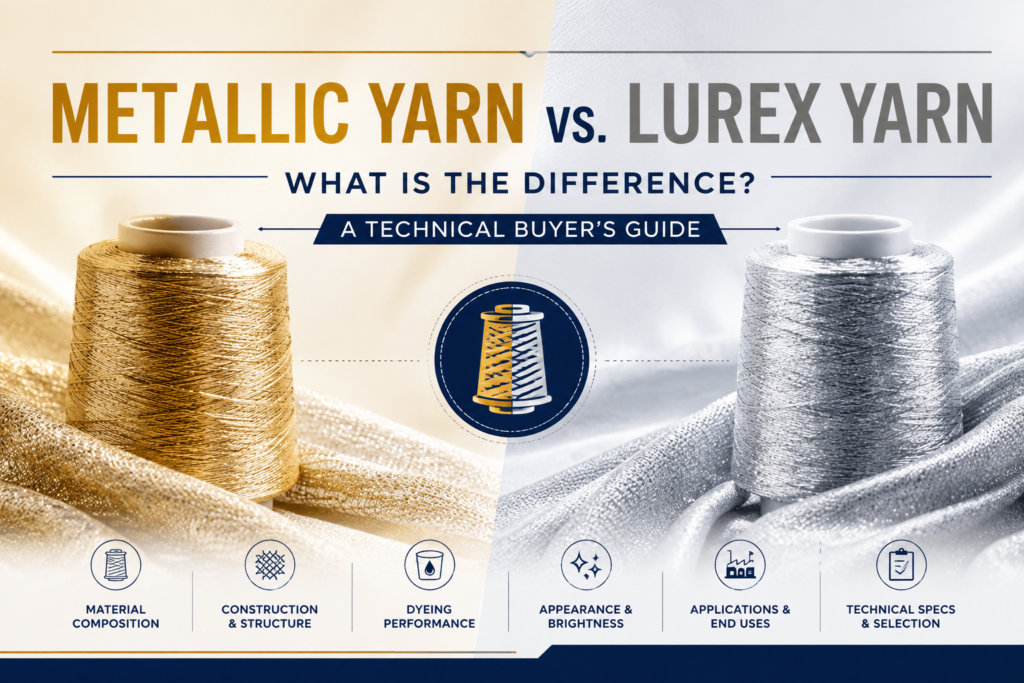
In the global textile supply chain, procurement managers, textile engineers, and brand sourcing directors frequently ask: “Is there an actual technical difference between metallic yarn and Lurex yarn?”
The short answer is: Lurex is a registered brand name, while metallic yarn is the generic industry classification. However, relying on brand recognition alone often leads to inflated raw material costs or misaligned material specifications.
For European and Western B2B buyers aiming to balance luxury fabric aesthetics with high-efficiency production, understanding the technical nuances between branded Lurex and engineered metallic yarns is key to eliminating downtime, reducing yarn breakage, and optimizing product margin.
1. Deconstructing the Terminology: Brand vs. Specification
To build a cost-effective material specification sheet, procurement teams must distinguish marketing terminology from technical engineering:
- Lurex Yarn: A trademarked brand name owned by the Lurex Company. Historically synonymous with metallic threads, branded Lurex carries a significant premium driven by brand licensing and intellectual property costs.
- Metallic Yarn (Generic): The industry-standard technical term for slit aluminum-polyester metalized film supported by or twisted with natural or synthetic core filaments (e.g., Nylon, Polyester, Rayon).
The Procurement Insight: Purchasing branded “Lurex” without evaluating generic metallic yarn specifications often results in paying a 20% to 35% brand premium for identical physical yarn structures (such as M-Type slit film or MX-Type double-covered yarn).
2. Solving Production Line Pain Points: Quality Metrics That Matter
Whether running circular knitting machinery at high speeds or weaving heavy jacquards on rapier looms, line efficiency dictates your final margin. Substituting or sourcing metallic yarns requires rigorous evaluation against three key production benchmarks:
A. Tensile Strength & Elongation (Reducing Loom Downtime)
Yarn snapping on high-speed rapier looms (800+ RPM) causes costly machine stops and fabric defects.
- The Solution: Ensure the core support structure matches the machine tension. Tongyang’s MX-Type double-covered metallic yarn utilizes counter-wrapped nylon/polyester filaments to shield the delicate inner slit film, delivering superior tensile strength and minimizing breakage under tension.
B. Tactile Comfort & Skin Contact (Eliminating Scratchiness)
In high-gauge knitwear, seamless bodywear, and activewear, stiff metallic filaments cause harsh skin irritation and customer returns.
- The Solution: Opt for MH-Type (single-covered) or ST-Type (twisted) series with ultra-fine film thicknesses (12µm). Tongyang’s specialized soft-touch MH yarns wrap the metallic filament with high-flexibility microfibers, achieving a smooth hand-feel without sacrificing sparkle.
C. Thermal & Chemical Resistance (Flawless Piece-Dyeing)
Inferior metallic films crack, delaminate, or lose color reflectivity during high-temperature garment dyeing or chemical washing.
- The Solution: Verify that the yarn utilizes a protective resin coating resistant to disperse dyeing at temperatures up to $130^\circ\text{C}$, as well as exposure to chlorine, salt water, and perspiration.
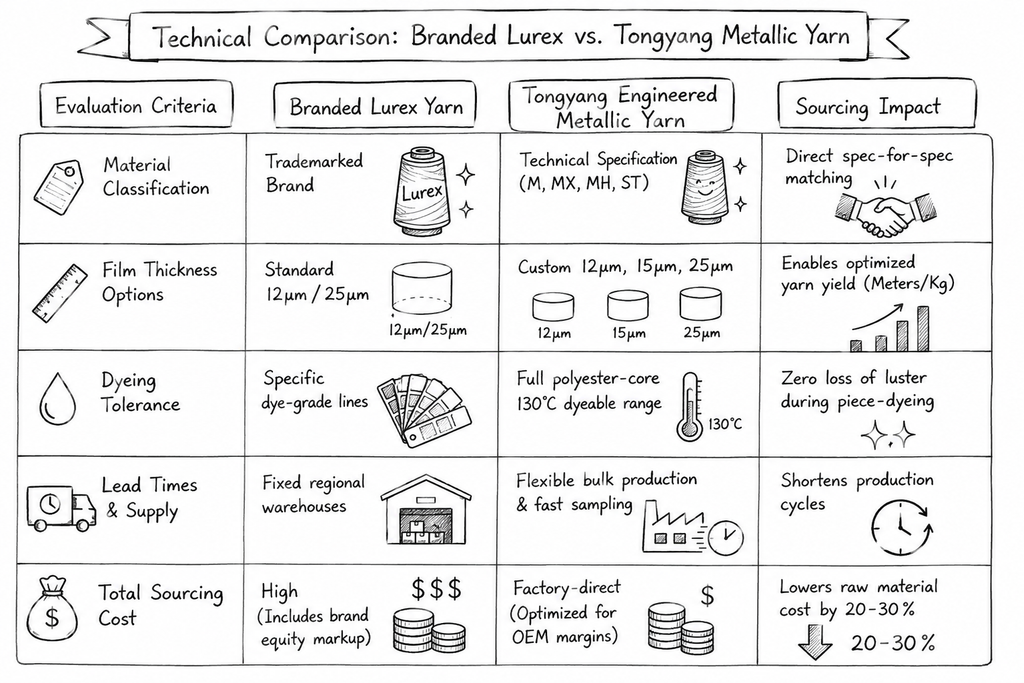
3. Technical Comparison: Branded Lurex vs. Tongyang Metallic Yarn
4. How to Transition from Branded Spec Sheets to Custom Sourcing
Replacing a legacy “Lurex” line item with an engineered metallic yarn requires three simple technical steps:
- Identify the Base Film & Core Structure: Determine if your current spec uses pure M-type slit film, MX double-coverage, or MH single-twisting.
- Calculate Required Denier & Yield: Match the film gauge (e.g., 1/69″, 1/100″) and core filament denier (e.g., 20D, 30D, 70D) to ensure identical yield per kilogram.
- Verify Compliance Standards: Ensure raw materials comply with global chemical and safety regulations (e.g., OEKO-TEX Standard 100, REACH compliance for European markets).
Streamline Your Metallic Yarn Supply with Dongyang Tongyang
At TONGYANG YARN (www.tongyangyarn.com), we bridge the gap between high-end fashion aesthetics and high-efficiency textile manufacturing. We supply global textile mills, fashion brands, and yarn distributors with precision-engineered M-Type, MX-Type, MH-Type, and fancy metallic yarns designed as direct, high-performance equivalents to traditional branded lurex.
Partnering with Tongyang Delivers:
- Zero-Defect Runnability: Strict yarn tension control for seamless integration on high-speed knitting and weaving machinery.
- Custom Color Matching & Formulation: Tailored metallic shades, matte finishes, and eco-friendly resin coatings.
- Direct Manufacturer Pricing: Cut out intermediary brand markups to significantly boost your fabric profitability.
Looking to lower raw material costs or eliminate yarn breakage on your production line?