How to Choose the Right Specialty Yarn for Your Textile Collection
Choosing the right yarn is an important part of textile product development. It affects not only how a fabric looks and feels, but also how it behaves during knitting, weaving, finishing, and everyday use.
For textile manufacturers, knitting mills, and apparel brands, standard yarns may meet basic production requirements but offer limited opportunities to create distinctive fabric effects. Specialty yarns provide more options, from metallic highlights and irregular textures to enhanced stretch and functional performance.
However, choosing a specialty yarn involves more than selecting a color or surface effect. Yarn count, fiber composition, construction, twist, machine compatibility, and finishing conditions can all influence the final result.
This guide introduces five common specialty yarn categories, explains their typical applications, and outlines the key factors to consider when sourcing yarns for commercial production.

1. Five Types of Specialty Yarns and Their Applications
Specialty yarns can be classified in different ways depending on their construction, appearance, and intended function. The following categories provide a practical starting point for textile designers, product developers, and sourcing teams.
1.1 Metallic & Lurex Yarns: Adding Shine and Visual Interest
Metallic and Lurex yarns are used to introduce reflective highlights and decorative effects into knitted and woven fabrics. Depending on their construction, they may feature metallic films, metallic-effect filaments, or combinations of these materials with conventional fibers.
They can be incorporated into a fabric as a prominent design element or blended with other yarns for a more subtle sheen.
Typical applications
- Fashion knitwear and statement sweaters
- Eveningwear and occasionwear
- Scarves, accessories, and decorative fabrics
- Selected hosiery and home textile applications
What to consider when selecting metallic yarns
The desired level of shine is only one consideration. Film or filament construction, yarn count, color consistency, surface feel, and resistance to breakage during processing should also be evaluated.
When metallic yarns are combined with cotton, viscose, polyester, or other fibers, sample testing can help establish whether the yarn is suitable for the intended machine, fabric structure, and finishing process.
1.2 Slub & Bouclé Yarns: Building Texture into the Fabric
Slub and bouclé yarns create distinctive fabric surfaces through variations in yarn structure.
Slub yarns feature intentional changes in thickness along the yarn length. These variations can produce an organic, irregular appearance that works well in casual knitwear and textured fabrics.
Bouclé yarns are characterized by loops or curls formed during yarn construction. Their raised surface creates a more pronounced dimensional effect.
Although both are classified as fancy yarns, their visual results and processing requirements can differ considerably.
Typical applications
- Sweaters and autumn/winter knitwear
- Textured fashion fabrics and coats
- Scarves and accessories
- Decorative cushions, throws, and selected upholstery fabrics
What to consider when selecting textured yarns
Pay attention to slub thickness and distribution, loop size, yarn count, and the consistency of the intended fabric effect.
Some structural irregularity is part of the design. However, excessive variation between production batches can cause unwanted stripes or inconsistent appearance in the finished fabric.
It is also important to confirm that the yarn structure is compatible with the intended knitting or weaving equipment.
1.3 High-Elastic & Dual-Curve Yarns: Stretch, Recovery, and Fit
For fitted garments and stretch-oriented textiles, yarn selection directly influences fabric flexibility, fit, and shape retention.
High-elastic yarns may use elastane or other elastic components, depending on the product construction. They can also be developed through different wrapping, twisting, covering, or texturing processes.
Dual-curve yarns are a more specialized category whose precise structure and performance depend on the supplier’s construction method. Their specifications should therefore be evaluated on a product-by-product basis.
Typical applications
- Stretch knitwear and fitted garments
- Selected activewear and athleisure products
- Seamless apparel and bodywear
- Other textile applications requiring controlled elasticity
What to consider when selecting elastic yarns
The most important parameters include yarn count, fiber composition, elongation, elastic recovery, processing tension, and compatibility with knitting equipment.
Heat setting, dyeing, and finishing can also affect the performance of elastic components. For this reason, a yarn that performs well in its original state should still be tested in the finished fabric.
Rather than relying on a general claim such as “high stretch,” manufacturers should define the required stretch and recovery performance for their specific application.
1.4 Chenille & Feather Yarns: Softness, Volume, and Surface Effects
Chenille and feather yarns are often selected when softness and a distinctive surface texture are important to the product design.
Chenille yarns typically feature a pile structure that creates a velvety appearance. Feather yarns generally have projecting fibers or filaments that produce a fluffy, feather-like effect.
Both can add visual volume and tactile interest, but they differ in construction, appearance, and processing behavior.
Typical applications
- Soft-touch sweaters and fashion knitwear
- Scarves and accessories
- Decorative cushions and throws
- Selected home textile and plush fabric applications
What to consider when selecting these yarns
Evaluate surface softness, pile or fiber retention, shedding, yarn strength, and the consistency of the finished fabric.
For products that undergo frequent washing or abrasion, testing should include the relevant care conditions. Fabric construction and finishing can have a significant influence on the final hand feel and durability.
1.5 Functional & Technical Blends: Selecting Yarns for Performance
Some textile applications require more than a distinctive appearance or comfortable hand feel. Functional and technical blends are developed to meet particular performance requirements through fiber selection, yarn construction, or specialized treatments.
Depending on the actual materials and processing methods, relevant properties may include UV resistance, flame retardancy, anti-pilling performance, abrasion resistance, or moisture management.
Not every functional property is available in every blend, and performance should never be assumed from the yarn category alone.
Typical applications
- Performance apparel
- Workwear and selected protective textiles
- Fabrics requiring improved resistance to pilling or abrasion
- Other application-specific technical textiles
What to consider when selecting functional yarns
Start with the finished product’s performance requirements. Confirm the applicable testing methods, required standards, fiber composition, and finishing conditions before choosing a yarn.
Where a property such as flame retardancy or UV protection is essential, request relevant test reports or technical documentation for the specific product and intended application.
2. Key Technical Parameters to Check Before Ordering
Once the yarn category has been selected, the next step is to confirm the technical specifications.
Yarn count should always be interpreted in the relevant counting system. Nm, Ne, denier, and dtex are not interchangeable without conversion, and their relationship to machine gauge also depends on the yarn structure and fabric construction.
For complex specialty yarns, the supplier’s technical data sheet and a representative production sample are generally more useful than a product name alone.
| Parameter | Why it matters | What to confirm with your supplier |
|---|---|---|
| Yarn count | Influences yarn thickness, fabric weight, and machine suitability | Count system, nominal count, and acceptable tolerance |
| Fiber composition | Affects hand feel, strength, dyeing behavior, and care requirements | Fiber percentages and any special components |
| Yarn construction | Determines the structure, appearance, and processing characteristics | Spinning, twisting, covering, texturing, or other relevant construction details |
| Twist direction and level | Can influence yarn stability, strength, and fabric appearance | S-twist or Z-twist, twist level, and plying structure where applicable |
| Elongation and recovery | Important for stretch-oriented applications | Test method, target elongation, and recovery requirements |
| Color consistency | Helps maintain a consistent appearance across production lots | Color references, lot consistency, and dyeing compatibility |
| Processing compatibility | Affects production efficiency and fabric quality | Machine gauge, feeding conditions, tension, and finishing requirements |
| Quality documentation | Supports product validation and purchasing decisions | Technical data sheets, sample evaluation results, and applicable test reports |
3. Matching Specialty Yarns to Your Product Development Goals
The most suitable yarn depends on the desired fabric effect, end use, manufacturing process, and target cost.
| Product development goal | Yarn category to consider | Key evaluation points |
|---|---|---|
| Add a subtle or pronounced metallic effect | Metallic & Lurex yarns | Shine, color, surface feel, and processing stability |
| Create an irregular or dimensional surface | Slub & bouclé yarns | Texture consistency, yarn structure, and machine compatibility |
| Develop stretch-oriented knitwear | High-elastic yarns | Elongation, recovery, fit, and finishing conditions |
| Create soft, fluffy, or velvety fabrics | Chenille & feather yarns | Softness, shedding, pile retention, and durability |
| Meet specific performance requirements | Functional & technical blends | Verified performance, testing standards, and end-use suitability |
These categories are starting points rather than fixed rules. A single fabric may combine multiple yarn types to achieve a particular appearance or performance profile.
For example, metallic yarns can be combined with conventional fibers to create a subtle sheen, while textured yarns may be paired with other yarns to balance surface interest, comfort, and fabric stability.
The final choice should be based on the actual construction and performance of the finished fabric, not just the visual appearance of the yarn cone.
4. Common Quality Issues to Check During Sampling
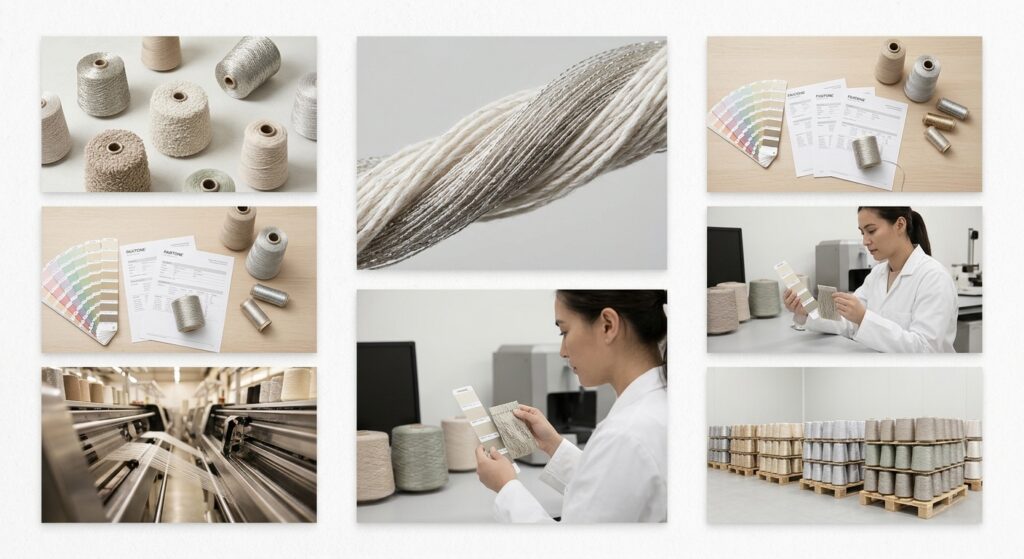
Specialty yarns can introduce specific quality considerations that are worth addressing before bulk production.
Metallic yarns: filament damage and breakage
Inspect samples for visible film separation, damaged filaments, or inconsistent metallic effects. Where relevant, evaluate yarn behavior under the tension and feeding conditions used in production.
Slub and bouclé yarns: inconsistent texture
Check whether slub distribution, loop size, and surface appearance are consistent with the approved sample. Uncontrolled variation can create unwanted visual banding in the finished fabric.
Elastic yarns: insufficient recovery
Evaluate stretch and recovery after knitting and finishing. Where the end product requires repeated washing or prolonged wear, include suitable performance testing.
Chenille and feather yarns: shedding and surface retention
Assess fiber loss, surface uniformity, and durability under conditions relevant to the finished product.
Multi-fiber blends: dyeing and color variation
Confirm dyeing compatibility and evaluate color fastness using appropriate test methods. Differences in fiber composition can lead to uneven dye uptake or color variation if the process is not properly controlled.
Across all categories, compare the sample against agreed specifications and record any critical requirements before confirming a bulk order.
5. From Yarn Sample to Bulk Production
A specialty yarn that looks attractive on a sample card may behave differently when processed on a knitting or weaving machine. Establishing suitability before bulk production helps reduce avoidable delays, quality issues, and material waste.
A practical evaluation process includes five steps:
- Define the end use. Identify the target fabric, garment, or textile product and its essential requirements.
- Confirm the specifications. Agree on yarn count, composition, construction, color, and any application-specific performance requirements.
- Evaluate samples. Check appearance, hand feel, processing behavior, and compatibility with the intended equipment.
- Test the finished fabric. Review dimensions, surface quality, elasticity, color fastness, or other relevant properties after finishing.
- Approve the production standard. Confirm the accepted sample, tolerances, packaging, and quality requirements before placing a bulk order.
This process is particularly valuable for fancy yarns, where structural characteristics are an important part of the product’s identity.
6. Frequently Asked Questions (FAQs)
Q1: What is the difference between standard yarns and specialty/fancy yarns?
Standard yarns focus on structural uniformity, strength, and consistent surface appearance. Specialty and fancy yarns are deliberately engineered with structural variations (such as slubs, loops, metallic films, or core-spun elastic components) to deliver specialized tactile, visual, or physical performance properties to the finished fabric.
Q2: How do I determine the correct machine gauge (GG) compatibility for specialty yarns?
Machine gauge compatibility depends on yarn count (Nm/Denier) and surface volume. As a general rule, fine-denier specialty yarns (e.g., 75D–150D) suit 12GG–18GG fine-knit machinery, while heavy fancy yarns (e.g., Nm 2.5–Nm 5) require coarse-gauge 3GG–7GG flat knitting machines. Our technical team can review your machine parameters and recommend optimal yarn counts.
Q3: Can metallic specialty yarns be washed normally in home laundry?
Yes, modern metallic yarns manufactured with high-quality polyester or nylon film backings exhibit excellent wash fastness. However, to maintain sheen and prevent micro-film abrasion, we recommend machine washing under mild cycles (30℃ ~40℃) and avoiding strong oxidative bleach agents.
Conclusion: Choose Specialty Yarns with the Finished Fabric in Mind
Specialty yarns offer textile manufacturers a broader range of possibilities for developing distinctive products. Metallic and Lurex yarns add reflective effects, slub and bouclé yarns create texture, elastic yarns support stretch-oriented designs, chenille and feather yarns introduce softness and volume, and functional blends address specific technical requirements.
The right choice, however, depends on more than the category name. Yarn construction, technical specifications, processing conditions, and the intended end use all contribute to the performance of the finished fabric.
For textile developers and sourcing teams, the most reliable approach is to define the product requirements first, compare suitable yarn specifications, and validate the selected material through sampling and production-relevant testing.
Looking for specialty yarns for your next project?
Tongyang Yarn works with textile buyers and manufacturers to discuss yarn options based on application, count, composition, construction, and quantity requirements.
Share your target product, machine requirements, and preferred yarn specifications to start a conversation about suitable materials and sample availability.
Ready to transform your design concepts into premium woven or knitted fabrics? Contact the engineering team at Tongyang Yarn today to request sample swatches and expert technical support.